PHOTO FRAMING · CENTERING · 2027 ERAS
What does “face is centered” mean for an ERAS headshot?
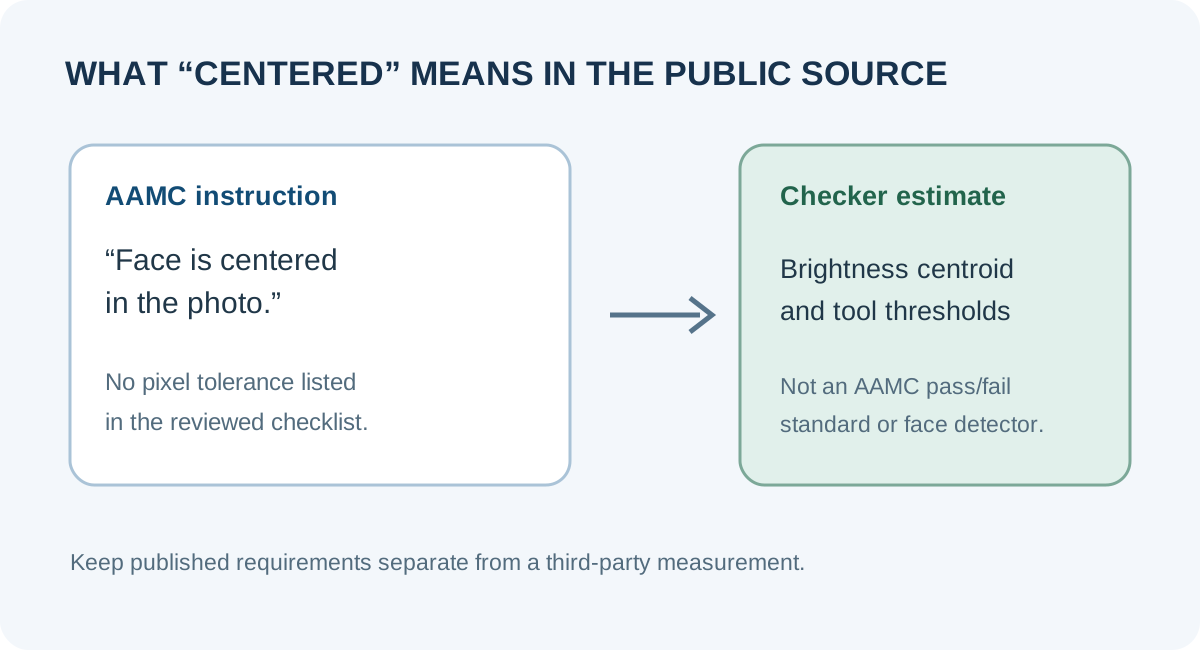
AAMC’s public ERAS photo instructions say “Face is centered in the photo,” but they do not publish a pixel tolerance or numeric face-center range. The horizontal and vertical thresholds shown by an online checker are that tool’s estimate—not an ERAS acceptance rule. Judge the visible face in the full image, and use the official wording as written.
What the public instruction says—and leaves open
AAMC’s current Photo instructions include one framing criterion: “Face is centered in the photo.” The public list also specifies JPG/JPEG or PNG and a maximum file size of 150 KB. In the centering line, however, AAMC does not give a coordinate, percentage, pixel radius, eye-line formula, or tolerance band.
That boundary matters. “Centered” is the published visual requirement; it does not authorize a third-party tool to invent a portal pass/fail cutoff. A checker may choose a number to summarize an image, but its number describes the checker’s own method. It cannot establish what MyERAS accepts or how a program’s display crops a photo.
Applicants have also publicly asked why a circular ERAS preview can crop the top of a head even when the opened image appears normal. Such posts are evidence that the preview-versus-original distinction causes real questions; they are not official documentation of what every program sees. For the preview question itself, see our guide to the ERAS preview and the uploaded image.
What this site’s centering estimate actually measures
The site’s checker does not recognize a face. It scales the uploaded picture to fit within a 300-pixel canvas, converts each pixel to a brightness value using 0.299R + 0.587G + 0.114B, ignores pixels at or below 100, and calculates a brightness-weighted centroid for the remaining pixels. It reports the centroid’s horizontal and vertical displacement from the canvas center. Its current label says “Estimated centered” when the displacement is under about 8% horizontally and 12% vertically.
Those percentages are code-level choices for a quick visual proxy. Brightness distribution can be affected by a pale background, a dark shirt, lighting, or other non-face content. A centered centroid does not prove that a face is centered; an off-center centroid does not prove that a face is misplaced. The checker page already explains general detection limits. This page isolates one narrower question: whether its threshold should be read as an official ERAS tolerance. It should not.
Because the test is synthetic, no applicant photo or private portal behavior is involved. The figures below use simple pixel patterns to expose what a brightness centroid can see. They test the arithmetic, not ERAS acceptance.
Reproducible test: can a no-face image be “centered”?
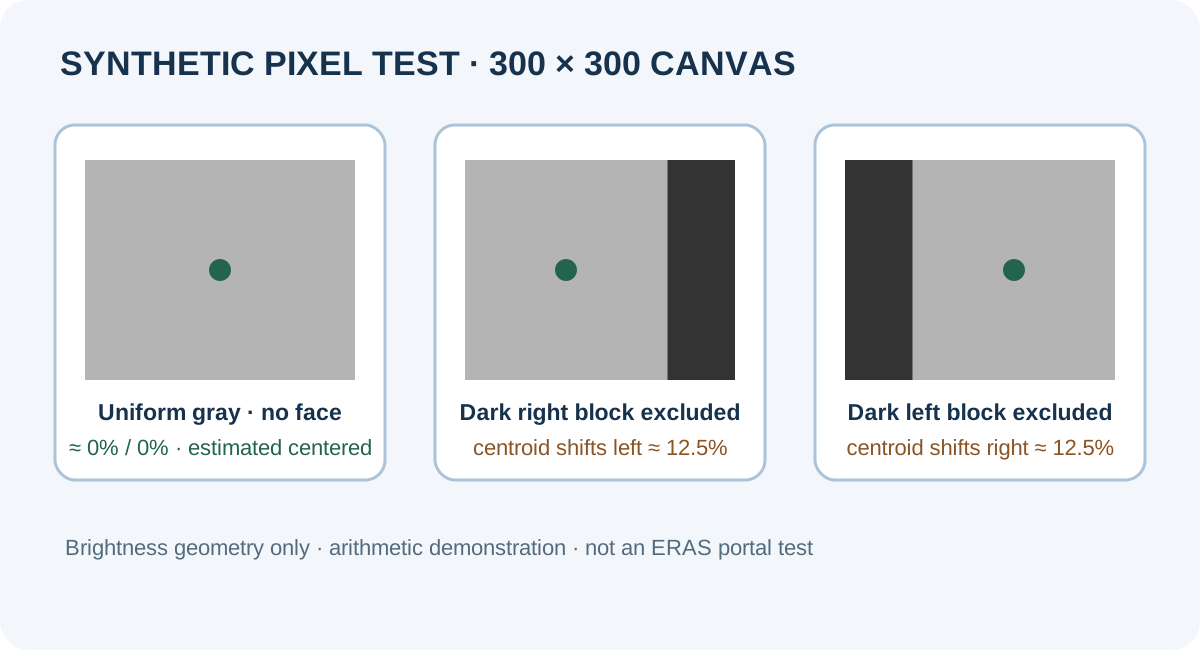
Method. Reproduce the checker’s 300 × 300 analysis canvas and its exact brightness equation, strict brightness > 100 inclusion test, brightness-weighted centroid, and strict thresholds |x offset| < 8% and |y offset| < 12%. Coordinates are measured from the canvas center (150,150). A control field is filled with RGB (180,180,180), so every pixel is counted equally. Then a person-free dark rectangle is added on the right, covering 25% of the canvas width and the full height. Finally, move the same rectangle to the left. This isolates brightness distribution; it does not model a human face.
- Control: uniform gray, no face-shaped object. The centroid is (149.5,149.5) under pixel-center coordinates: approximately (0%, 0%), so the tool labels it estimated centered.
- Dark block on the right: because its pixels fall below the brightness cutoff and are excluded, the remaining bright pixels are weighted toward the left. The centroid moves left, even though the block itself is on the right.
- Dark block on the left: the same exclusion shifts the centroid right. The sign reverses when the omitted dark area is mirrored.
The first result is the important counterexample: an image with no face at all can satisfy a brightness-centroid centering test. The mirrored block cases also show that a dark feature can move the reported centroid in the opposite direction from the feature. Therefore, the output is a property of counted bright pixels, not a measurement of face anatomy.
Reproduction steps: create a 300 × 300 RGB image; fill it with 180 gray; optionally paint a full-height dark region of width 75 pixels on one side; compute the weighted centroid over pixels brighter than 100. For a uniform field, symmetry places the result at the center (within the half-pixel convention used by the browser canvas). The exact mathematical thresholds are 24 pixels horizontally (8% of 300) and 36 pixels vertically (12% of 300), with values exactly on either boundary failing because the code uses “less than,” not “less than or equal to.”
This is a deterministic reproduction of the published site code, not an independent sample of real portraits, not a browser test of MyERAS, and not a claim about program display. It is useful for understanding the checker’s output, not for accepting or rejecting a headshot.
A source-bounded way to read a centering message
- Read the official criterion literally. AAMC says the face is centered. Do not replace that wording with a made-up pixel range.
- Inspect the whole source image. Check whether the visible face appears balanced within the complete frame, rather than relying only on a circular thumbnail or a brightness number.
- Keep tool language in its lane. “Estimated centered” means this checker’s brightness centroid fell within its code thresholds. It is neither official approval nor proof that the face was found.
- Separate original from preview. If the portal preview looks cropped, compare the original file and the displayed preview as separate views. Public instructions do not specify every preview crop or guarantee that all program interfaces look identical.
- Use the route’s official help when the account view is unclear. Ask about the exact screen and current application route; do not infer a hidden tolerance from a third-party checker.
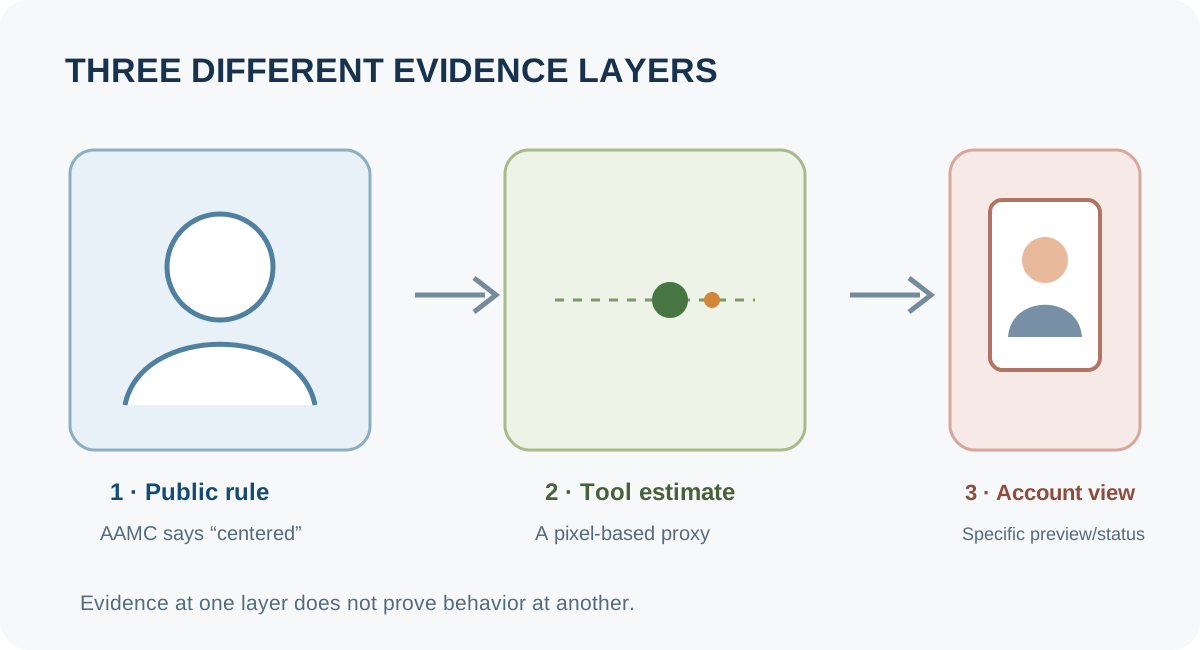
This workflow preserves what each piece of evidence can answer: the official checklist states the requirement, the source image shows its framing, a local checker provides a limited estimate, and the logged-in portal shows account-specific status. None should be substituted for another.
Common questions
Does ERAS publish an exact centering percentage?
The AAMC Photo page reviewed here says “Face is centered in the photo” but does not state a numeric tolerance. This is limited to the public instructions reviewed, not a claim about unpublished internal systems.
Is the checker’s 8% horizontal limit an AAMC rule?
No. It is a threshold used by this site’s brightness-centroid estimate. It is not sourced from AAMC and cannot predict portal acceptance.
Can a checker find my face?
This checker does not perform face recognition. It estimates the center of bright pixels, which can be influenced by background and clothing.
What if the circular preview crops my head?
A public applicant post documents this question, but a post cannot settle what all programs see. Compare the source file and the portal’s available image view, then use the account’s official help path if the result remains unclear.
Does “estimated centered” mean the photo passes?
No. It only describes the checker’s measurement. Follow the current official instructions and the status shown in your own account.
Video explainer
This English explainer restates the published AAMC wording and the synthetic brightness-centroid test above. The narration is AI-generated and English subtitles are included; I have not independently listened to the audio.
Sources and scope
- AAMC, Photo — public wording states “Face is centered in the photo”; no numeric tolerance appears in the reviewed checklist.
- r/medicalschool, “Need confirmation on this ERAS photo upload” — September 2026 question about circular-preview cropping; used only as evidence of a real question, not an official answer or a representative outcome.
- Residency Headshot checker source — current client-side brightness-centroid implementation and thresholds, inspected November 20, 2026.
Sources and the checker implementation reviewed November 20, 2026. No private applicant account was accessed. The synthetic cases are arithmetic demonstrations, not tests of ERAS software. Residency Headshot is independent and is not affiliated with AAMC, ERAS, Intealth/ECFMG, EFDO, or any residency program.